How to Convert MOV to WMV on Different OSs
Knowing how to convert MOV to WMV enables users to create files with seamless compatibility between different operating systems and programs. To do that, you need a reliable video converter.
MOV, commonly associated with Apple devices, might pose playback challenges on Windows PCs. However, transforming them into WMV resolves such issues.
This article describes 3 methods to efficiently convert MOV to WMV. One is for a Windows-based device, one is for a macOS computer, and another online. The guide offers step-by-step instructions and highlights the pros and cons of each option. It also provides a comparative analysis of the two video types.
Way 1. Movavi Video Converter
If you are owning a computer with the Windows OS and have received a MOV video, not all your programs may open the file. One of the solutions is to employ a MOV to WMV converter.
This app has a user-friendly interface but offers robust features, like changing to and from a variety of formats - MOV, AVI, WMV, and MKV. It also supports turning a visual into audio - MP3, OGG. You can even make a GIF out of your footage.
How to efficiently convert MOV to WMV on Windows
- Visit the website and download the software. Follow the on-screen instructions.
- Once installed, launch the application. Click the "Add Media" button. Select "Add Video" to import the items. Alternatively, drag and drop the clips directly into the main window.
- Open the "Video" tab and choose "WMV" from the list of available extensions. Change the settings preset to what best fits your requirements.
- Specify the destination folder. Hit "Convert" to initiate processing.
- The progress bar will display the status. To access the WMV video, tap "Folder" next to the output field.
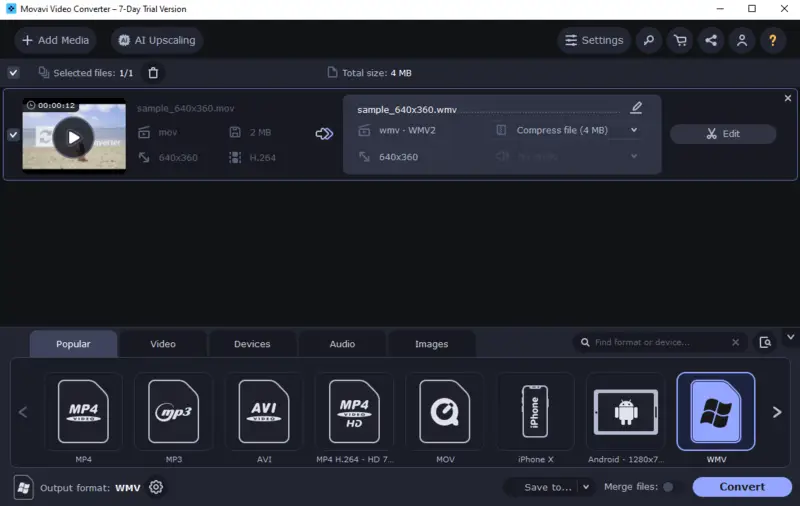
Pros:
- Intuitive Interface. The video file converter offers a friendly UI, making it easy for beginners to navigate and utilize the software without much hassle.
- Wide Format Support. The program works with a vast array of extensions, enhancing its versatility.
- Preset Options. The software provides preset options for various devices and resolutions, ensuring optimal output without requiring in-depth technical knowledge.
Cons:
- Limited Usage. There is no free version. The free trial lasts 7 days only.
- Resource Intensive. During video conversion, the app may consume a considerable amount of system resources, potentially slowing down older or less powerful computers.
In general, Movavi Video Converter is a reliable tool for efficiently turning MOV to WMV on Windows. It supports a wide range of input and output options. Yet, the subscription may be costly for those on a low budget.
Way 2. 1-Click Video Converter
If you know that the receiver of your film has a Windows PC but you own a macOS device, you may want to make it easier for them and convert your video file before sharing. A good option to do this for free on a Mac is 1-Click Video Converter.
This software can transform almost all container types like MTS, M2TS, TS, TRP, MP4, MOV, M4V, MKV, AVI, WMV, FLV, WTV, MP3, FLAC, WMA, and more.
How to convert MOV to WMV on macOS
- Go to the App Store and download the program. Set it up.
- Open the utility. Click "Add Files" to import the MOV.
- Look for the "Profile" drop-down menu and choose "WMV" as the output.
- Adjust "Settings" if needed and pick the "Destination" folder. Hit "Convert".
- Once the task is complete, the utensil will automatically save videos in the designated location.
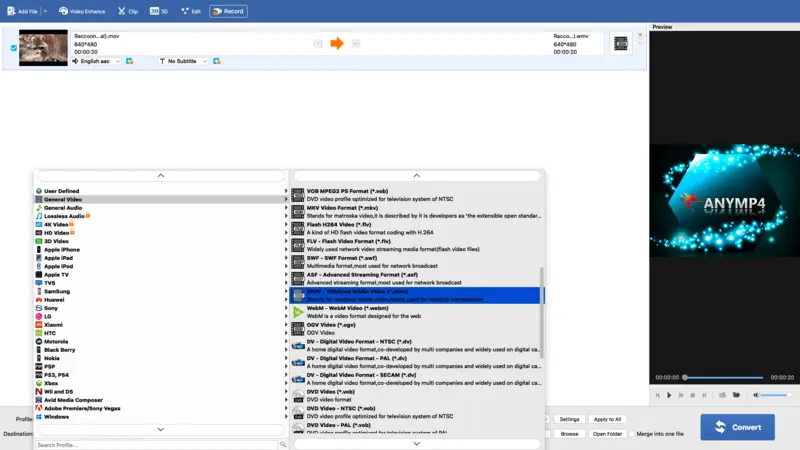
Pros:
- Simplicity. The app has a straightforward interface, making it suitable for beginners with minimal technical knowledge.
- Variety of Extensions. The video converter offers a long list of options.
Cons:
- Limited Customization. Lacks advanced adjustments, which might be necessary for specific quality or format requirements.
Overall, 1-Click Video Converter is a great solution for macOS owners to change the footage type or convert it to audio.
Way 3. CloudConvert
If you're working with a MOV file and need to modify it to WMV for better playback, CloudConvert is a great online service to try.
How to convert MOV to WMV in browser
- Visit the CloudConvert website.
- Click "Select File" to add your clip from your computer, Google Drive, Dropbox, or via URL.
- Once it is uploaded, use the "Convert to" dropdown to opt for WMV as the output type.
- Optionally, you can tweak the resolution, bitrate, or audio quality.
- Hit the "Start Conversion" button to begin the task. When it is complete, save your WMV.
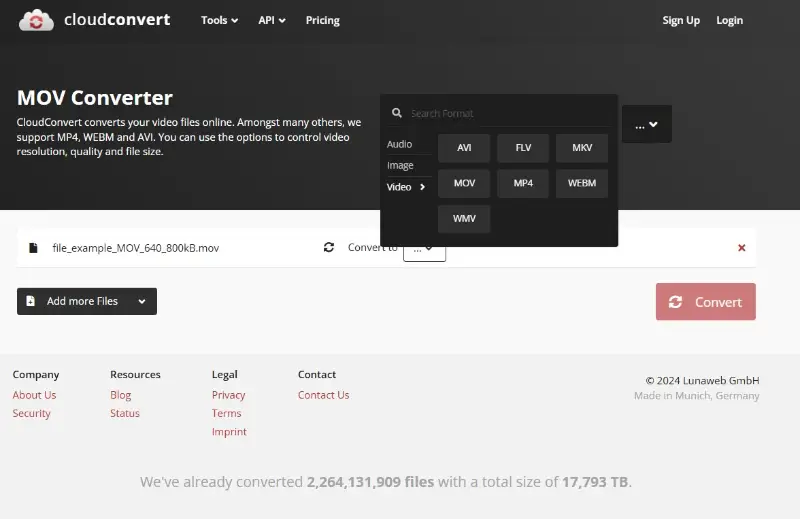
Pros:
- No Installation. As a web-based tool, it doesn’t require any downloads, making it a go-to option when you have an internet access.
Cons:
- Limits. The free version has restriction on the number of operations, which can be a limitation for large collections.
CloudConvert is a convenient solution for converting MOVs to WMV. It’s a quick, accessible tool, especially for users who don’t want to install extra software.
MOV vs WMV
MOV (QuickTime File Format) and WMV (Windows Media Video) are two big names. Apple created MOV, while WMV comes from Microsoft. Naturally, each one feels most at home on its own company's operating systems.
MOV and WMV comparison:
| Characteristic | MOV | WMV |
|---|---|---|
| Developers | Created by Apple, MOV integrates effortlessly with macOS and iOS, making it a natural choice for Macs, iPhones, and other Apple hardware. | Designed by Microsoft, WMV is optimized for Windows environments and works smoothly within its native ecosystem. Outside of Windows, playback often depends on installing additional codecs. |
| Compression | MOV commonly uses MPEG-4 and facilitates standards like H.264, allowing it to preserve high visual clarity without ballooning sizes. | WMV is built around Microsoft-specific codecs such as WMV9, delivering reasonable reduction and clarity, though it generally falls short of MOV's sharpness. |
| Editing Capabilities | MOV is widely preferred for professional purposes, offering strong compatibility with advanced redaction tools and flexible handling of sound, visuals, and captions. | WMV supports altering but can struggle in high-end production, where its limited adoption may slow down complex tasks. |
| Usage | MOV dominates Apple-centric workflows, including content creation and streaming, thanks to its adaptability and polished performance. | WMV is frequently applied in Windows-focused scenarios like broadcasting, presentations, and conferencing. |
When it comes down to it, MOV really shines in fidelity and redacting - especially if you’re Mac owner. WMV, on the other hand, organic to Windows and handles distribution without breaking a sweat.
So, which one should you pick? It really depends on where you plan to utilize your footage and how much editing you want to do. If you're all about flexibility, especially on Apple devices, go with MOV. If you need tight Windows integration or you’re focused on slideshows, WMV gets the job done.
Reasons to convert MOV to WMV
Sometimes you have to switch a MOV over to WMV. There are a few good cases for it: you might run into operability headaches, need to employ certain software, or want life to be a little easier.
Cross-Platform Compatibility
If you’re working on Windows, WMV is the way to go. It plays nice with pretty much every video editor out there. Changing from MOV to WMV means no more "file not supported" messages, and you can share your clips without worrying if they’ll play.
Software Limitations
Let’s be real: not every app likes MOVs. Some programs are picky and only wish WMV. If your program, player, or workflow demands WMV, converting your videos keeps everything running smoothly.
Compression
Nobody wants to deal with giant files. WMV does a solid job minimizing footage without wrecking the quality. So, if you’ve got a huge MOV, turning it into WMV can make it smaller.
Specific Requirements
Sometimes, it’s just about what the platform demands. Maybe a website, a presentation tool, or a streaming service only takes WMV uploads. When that’s the rule, modifying your film isn’t optional, it’s the only way forward.
Tips for MOV to WMV conversion
- Check codecs – MOVs usually run on H.264 or ProRes; WMV likes WMV9 best.
- Set a good bitrate – Crank it up for better quality, but remember your file gets bigger, too.
- Match frame rate & resolution – Keep these settings the same so your visual doesn’t stutter or lag.
- Convert audio if needed – MOV often uses AAC, but WMV handles WMA better.
- Skip re-encoding – If your codecs already line up, don’t bother with them.
- Test the output – Open it up in Windows Media Player and verify everything operates smoothly.
How to convert MOV to WMV: FAQ
- Will I lose quality when converting MOV to WMV?
- You’ll usually see a bit of fidelity drop. That’s just what happens when you compress things or switch codecs. Still, if you go with HD settings and use a good video converter, you can keep that loss pretty minimal.
- Will the file size change?
- Yep, it probably will. WMVs shrink down compared to MOV. All depends on your original, the parameters you pick, and what software you employ. Sometimes the difference is huge, sometimes not so much.
- Are there any recommended settings for optimal WMV conversion?
- If you want solid results, crank up the bitrate, opt for a resolution that matches your needs, and choose the right codec. These tweaks help keep the video looking sharp.
- Can I convert WMV back to MOV if needed?
- Sure, you can turn files back into MOV via the same program you used for the first modification. Just remember, every time you do this, you might lose a bit more quality - it’s part of the deal with transcoding.
- What should I do if the output is corrupted?
- Don’t panic. Try a different app, play around with the settings, or update your utility. Also, ensure your media player supports WMV. Sometimes it’s just a compatibility hiccup.
- Can I batch convert multiple MOV files to WMV at once?
- Absolutely. Load them up, set your preferences, and let the tool handle everything at once. It’s a huge time-saver.
- Are there any advanced ways?
- If you’re feeling technical, FFmpeg is your friend. This command-line utensil gives you tons of control: tweak encoding, automate conversions with scripts, or process a whole folder in one go. For example, using ffmpeg -i input.mov -c:v wmav2 -b:v 1500k output.wmv turns your MOV into WMV with specific codec and bitrate.
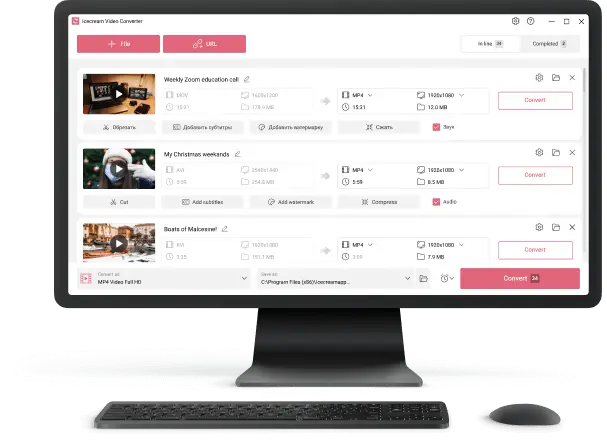
Conclusion
In conclusion, learning how to convert MOV to WMV format bridges compatibility gaps between different operating systems and software. Whether for cross-platform playback, file size optimization, or meeting apps specifications, this conversion process serves as a practical solution.
Mastering the art of MOV to WMV conversion expands accessibility and enhances flexibility in editing video content, catering to the dynamic needs of today's multimedia landscape.

Editor-in-Chief at Icecream Apps
Co-authors

Expert Tech Writer