How to Add Captions to a Video on a PC
You need to know how to add informative captions to videos if you want people to be able to follow along with your video guides even when it's loud or there isn't any sound. This is great for making personal projects, training materials, or posts on social media.
You don't need to buy expensive software to make captions. There are free video editors that do a good job.
In this guide, we’ll walk you through the process step-by-step, using one such program to add subtitles to your video with ease.

What are video captions?
Captions are written versions of spoken dialogue, sound effects, and other relevant audio that are in sync with the content.
How to add captions to a video?
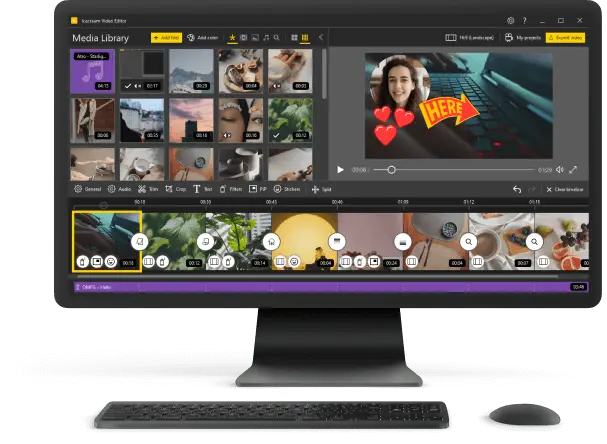
Icecream Video Editor is an easy-to-use free video editing software for Windows. You can make and change projects by putting together clips, pictures, and audio files.
It has a lot of features, like the ability to trim videos, add transitions, filters, and captions or text.
Step 1: Install the video editing app
Visit the official website and download free video editor for Windows. Run the installer and follow the prompts to set up the software on your computer.
Step 2: Import your video
After you install it, you can start the program from the desktop shortcut or the menu.
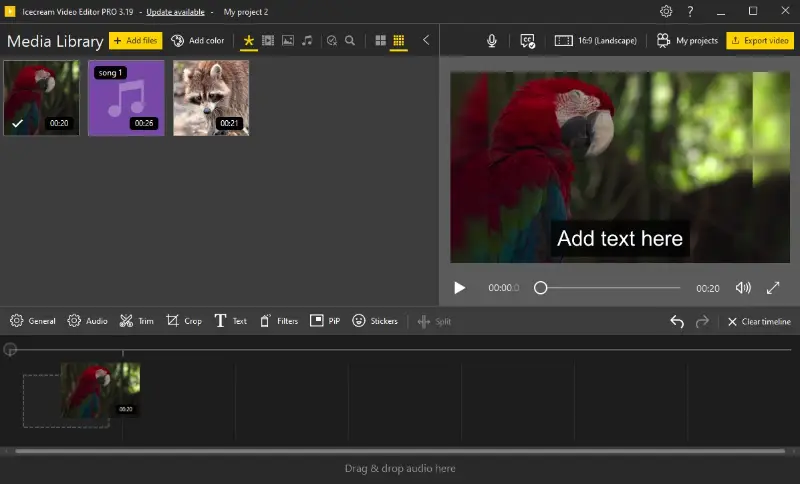
Use the "Add files" button or drag and drop your clip into the media library. Once imported, drag it from the library to the timeline at the bottom of the screen.
If you're working with more than one file, put them in the order you want them to be in.
Step 3: Add desired captions to a video
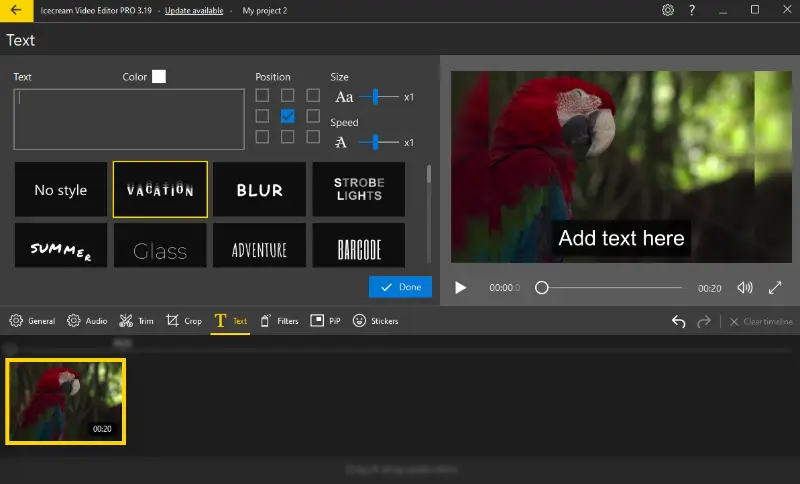
Click the "Text" option on the toolbar above the timeline.
Create the captions for your video and position the overlay where you want the text to appear on the screen.
Most of the time, video captions are placed in the bottom center so they are easy to see without blocking anything.
Step 4: Customize captions for your video
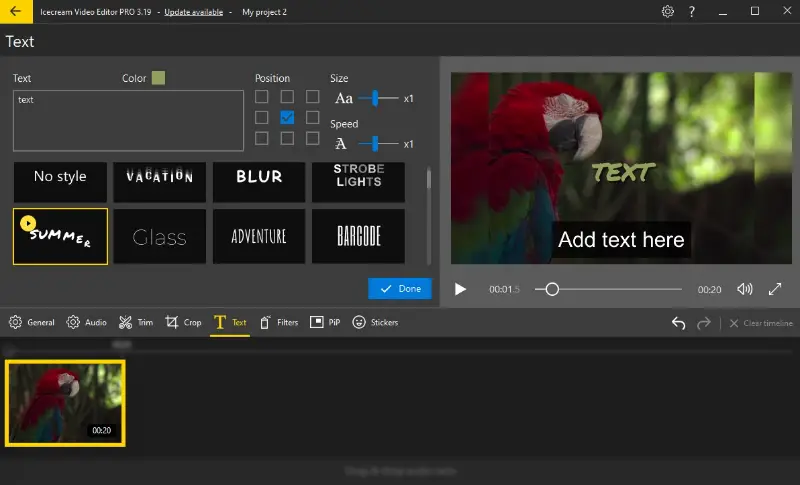
Choose a style that fits your project, and then try the formatting tools (speed, size, color) to make it look how you want it to.
Step 5: Add more video captions
To place more text, repeat the process by adding new overlays and putting them in the right place.
Check to see if the captions line up with the audio or visuals by playing it back. Make small changes as needed.
Step 6: Export the result
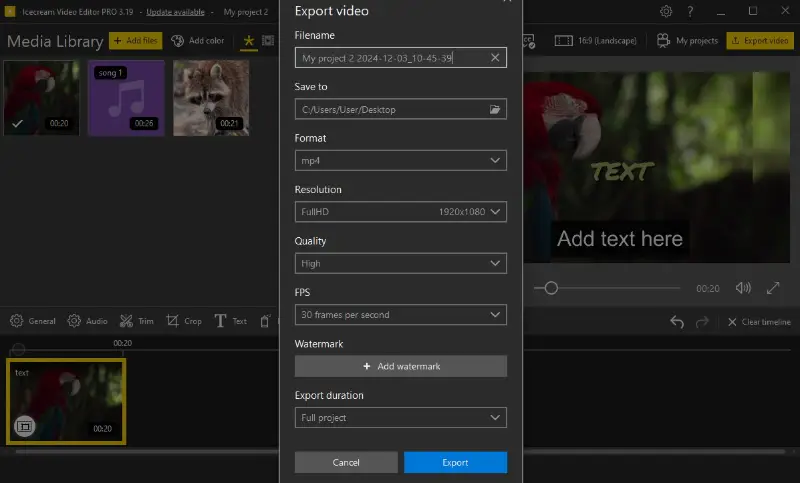
Once you’ve added all captions and reviewed the final clip, hit the "Export video" button at the top right corner.
Pick the destination folder, the output format, the resolution, the quality, and the FPS. You can also add a watermark if you need one.
Click "Export" to save your video with captions. Depending on the length and resolution, this may take a few minutes.
Why add captions to a video?
Adding captions to your video serves several purposes:
- Makes content accessible to viewers who are deaf or hard of hearing.
- Ensures compliance with accessibility regulations, such as ADA or WCAG guidelines.
- Helps non-native speakers understand the information more easily.
- Aids viewers in noisy environments where audio may be hard to hear.
- Improves search engine indexing, making the video more discoverable.
- Allows content to be localized and translated, widening its global appeal.
- Reinforces understanding by presenting information in both visual and textual formats.
Video captions formats
| Format | Description | Best For |
|---|---|---|
| SRT (SubRip Subtitle) | Simple text format with timestamps. | Most platforms (YouTube, Facebook, VLC). |
| VTT (WebVTT) | Similar to SRT but offers styling and positioning. | Web videos, HTML5 players. |
| SSA/ASS (SubStation Alpha) | Supports advanced styling, fonts, colors, and effects. | Anime, karaoke, heavily styled. |
| SBV | Text-based format similar to SRT but specific to YouTube. | Uploading to YouTube. |
| CAP (Cheetah/Scenarist) | Used in television. | Professional TV and broadcast. |
| STL (EBU STL) | Standard for European TV. | Broadcast and professional editing. |
FAQ
- How do captions differ from subtitles?
- Subtitles usually translate spoken dialogue into another language, while captions also include non-speech elements like sound effects and speaker identification.
- What are closed captions?
- Closed captions can be turned on or off by the viewer, unlike open ones, which are always displayed on the screen.
- What are descriptive captions?
- They include information about background sounds, tone of voice, and other audio cues to enhance comprehension.
- What are live captions?
- They are made in real time during live events or broadcasts, and they are often done by AI or people.
Conclusion
It doesn't have to be hard or expensive to add the captions to your videos.
With a free video editor, you can quickly make your content accessible to a wider audience.
Creating titles not only improves viewer engagement but also demonstrates inclusivity. Now that you know how to do it, start captioning your projects today and make a lasting impact!

Expert Tech Writer